
Pitt-BWF Physician Scientist Incubator
Summer 2026
This quarter, we are proud to highlight and share a homage to our program graduates and welcome our incoming scholars. We are also proud to feature current BWF Scholar - Dr. Michelle Roe. We also share the latest presentations and recent publications from our Scholars. In addition, we’ve included a list of upcoming Incubator classes and events.
The Physician Scientist Incubator is a program that was developed in 2018 to enrich the pool of MD/DO only physician scientists. The Incubator has matriculated 8 cohorts for a total of 53 Scholars. To date, Scholars have over 300 authorships since joining the program. The goal of the program is to train the highest quality biomedical investigators by building their scientific, professional, and resiliency skills necessary to become and persist as a successful physician-scientist. Resident and fellow Pitt-BWF Scholars from multiple departments benefit from a structured curriculum, writing groups, executive coaching, and time-saving initiatives.
Program Graduates
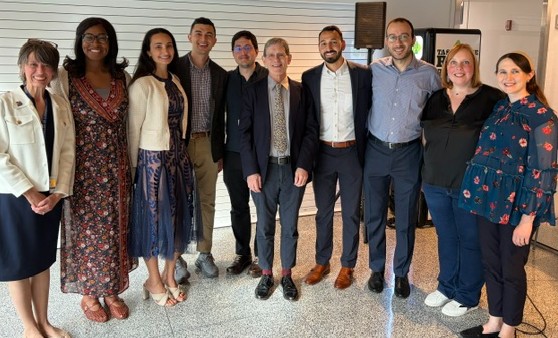
The highlight of the Summer was a joyful graduation ceremony for our program graduates. On June 4, 2026, graduating scholars, joined by mentors, gathered to celebrate with one another. We are very proud of these individuals as they move on in their training and/or careers.
Hannah Rinehardt, MD, General Surgery Resident - Dr. Rinehardt’s project was “Mouse Model of Intraductal Papillary Mucinous Neoplasm.”
Jetina Okereke, MD, Postdoctoral Scholar, Pulmonary, Allergy, Critical Care, and Sleep Medicine - Dr. Okereke’s project was “Investigating Accumulation of Granzyme K in Hypofunctional T cells.”
Katherine Lyman, MD, Clinical Assistant Professor, T32 Postdoctoral Scholar, Psychiatry - Dr. Lyman’s project was “Seasonal Patterns of Gene Expression in Psychiatric Disease.”
Ryan Zeh, MD, General Surgery Resident - Dr. Zeh’s project was “Artificial Intelligence Applications in Radiomics and Computer Vision for Precision Surgical Oncology.”
Sahar Alimohamadi, MD, Integrated Vascular Surgery Resident - Dr. Alimohamadi’s project was “Genetic Variants in the LPA Locus and Risk of Peripheral Artery Disease: A Two-Stage Analysis in the All of Us Research Program."
Sakibul Huq, MD, Chief Resident, Neurological Surgery - Dr. Huq’s project was “Genomics of Skull Base Tumors.”
Yannis Hadjiyannis, MD, Pathology Resident - Dr. Hadjiyannis’ project was “Advanced Studies in Transplant Tolerance Induction and Regulatory Dendritic Cell Biology.”
Dr. Steinman wrote and shared sonnets to honor our graduates:
“A Sonnet Homage to the 2026 BWF Graduating Class”
From Richard Steinman MD, PhD
1
The cycling thoughts of summer, spring and fall:
anticipating freeze by charging up
a periodic riot – that green sprawl
a jolt of ATP in soil. Build-up
of buried mito juice. What genes could juice
a psychiatric summer of disease?
With biopsies in hand, Katherine sleuthed
the ebb and swell of transcripts. Solved the Sea-
son of Bipolar in the Brain. R. Zeh
puts AI eyes into the OR suite.
If pancreatic cancer skirts the blade
he’ll catch its trail. His genius accretes
new projects by the day. In class his head
and heart captured the eye. New code for wed.
2
When hosts push donor liver off the plate,
he found the jak-stat garnish ruined the taste.
Then Yanni used DC’s to marinate—
not any type—just DCreg. He placed
the meal—success! Forget the drugs. He showed
through flow and labs no tacrolimus need.
How tired T cells get! Surveil a load.
Gets hard to flaunt a proper role. Accede
to helping scar the lung in IPF.
It’s Tina’s work that designates the how.
She’ll find the way to make immune cells deaf
to pathogenic age, clones to allow,
new drugs to bring a world of breathe again.
Then sarcoidosis is her next domain.
3
Too busy to say no, this surgeon smiles
as her adrenals pump. Hannah insists
to tame the wayward pancreas, its guiles
subdued. The how of choledochal cysts.
The genes to flip the alpha type of cell,
IPMN a vinegar dissolve.
Imagine when blood loses its propel
through arteries of limbs. Pain won’t resolve
and movement’s just a dream. Sahar steps in
when plumbing’s not the cure. What RNA
in platelets has induced their clotting grin?
She’ll probe transcriptomes, find cause of dismay
that follows failed operative attempts.
A gain for AllofUs. No clot. Preempt.
4
Meningiomas. Has the sound of music
peak and fall. But Sakibul has seen
hormonal mischief shift the song to sick.
How does progesterone’s baton careen
these vital cells to discord and to spread?
He’ll find the clues in blood and brain. It’s Sak’s
precision crystal ball. Glioma thread-
ed light to guide the knife to cut its tracks.
Disease must quail at such a potent team:
a brew of brilliance, drive and grit unleashed
in lab, in silico, fired up with steam
of synergized and shared ideas. A feast
of specialties in class. Delight to know.
Physician scientists--these Scholars--glow.
Incoming Scholars
We welcomed the newly appointed Pitt-BWF Scholars:
Joseph Bean, MD, General Surgery Resident
Parham Habibzadeh, MD, MS, Internal Medicine Resident
Maria Lane, DO, Pediatric Hematology/Oncology Fellow
Allyson Lieberman, MD, PhD, Pulmonary, Allergy, Critical Care, and Sleep Medicine Fellow
Emily Mosher, MD, Vascular Surgery Resident
Sarbajeet Nagdas, MD, PhD, Hematology/Oncology Fellow
Umayal Sivagnanalingam, MD, MS, General Surgery Resident
Featured Scholar
 Michelle Roe, MD is a is a Pediatric Hematology/Oncology Fellow and current BWF Scholar. Her research focuses on CAR T cell therapy for Ewing sarcoma. She works under the mentorship of Drs. Jason Lohmueller and Kelly Bailey.
Dr. Roe’s research is focused on the application of universal CAR T cells for Ewing sarcoma, a primary bone malignancy seen most frequently in adolescents and young adults. Patients with relapsed Ewing sarcoma face a nearly uniformly fatal prognosis and are in desperate need of novel therapeutic options. One of the major challenges in targeting relapsed Ewing sarcoma is tumor heterogeneity. To address this obstacle, Dr. Roe is testing a new CAR T cell technology that uses chimeric antigen receptors (CARs) to bind common tag molecules conjugated to antibodies targeting specific tumor associated antigens. This universal CAR T cell platform allows for simultaneous targeting of multiple surface proteins through different antibodies recognized by a single engineered universal CAR T cell. She hypothesizes that a universal CAR T cell therapy targeted against two (or more) surface proteins highly expressed in pediatric Ewing sarcoma will improve efficacy by circumventing resistance due to tumor surface antigen expression heterogeneity.

Why have you decided to pursue a career as a physician scientist? Dr. Roe shared, “My decision to pursue a career as a physician-scientist stems from a commitment to improve outcomes for pediatric cancers that still carry dismal prognoses. While caring for young patients is a profound privilege, witnessing them battle treatment-resistant disease highlights both the limits of current standard care and the urgency to innovate beyond them. To me, the clinic and laboratory are mutually reinforcing. Bedside encounters formulate the exact questions that propel my research, while laboratory investigation yields the tools to build targeted solutions. Ultimately, the unique dual perspective of a physician-scientist merges clinical insight into complex disease with the scientific framework required to engineer transformative therapies.”
What are your future career goals as a physician scientist? Dr. Roe shared, “My long-term goal is to establish an independent laboratory dedicated to translating universal CAR T-cell platforms from bench to bedside. Building on my current work evaluating strategies to overcome antigen heterogeneity and limit systemic toxicity in solid tumors, I plan to leverage translationally relevant models to optimize therapies for clinical use. Guided by strong mentorship and institutional support, I aim to lead an academic research program that moves novel immunotherapies into early-phase clinical trials, offering meaningful new treatment options to pediatric patients with dismal prognoses.”
Latest Scholar Presentations
Dr. Anthony Gebran won the Best Oral Presentation award at the Department of Surgery 24th Annual Simmons Surgery Research Day held on May 13, 2026, for his work titled, “GLP-1RA Therapy Reverses the MASH-Driven Pro-Metastatic Hepatic Niche and Reduces Colorectal Liver Metastases.”
Dr. Ander Dorken-Gallastegi won a Best Poster award at the Department of Surgery 24th Annual Simmons Surgery Research Day Research Day held on May 13, 2026.
Dr. Catherine Corey gave an oral presentation of her work titled, “The Inflammatory Cost of Undernutrition for Bone Health: INFƔ, TNF⍺, and IL-8 Pro-inflammatory Mediators are Associated with Low Hip BMD in Anorexia Nervosa” at the Santa Fe Fellows Workshop on Metabolic Bone Diseases, July 28-30, 2026.
Dr. Emily Mosher presented 3 posters at the International Society on Thrombosis and Haemostasis, Annual Meeting held on July 13, 2026, in Paris, France:
- Mosher EE, Andraska EA, Muller M, Luttrell-Williams E, Murphy L, Reynolds HR, Hochman JS, Goldberg IJ, Kornblith LZ, Neal MD, Barrett TJ, Berger JS. Female sex is associated with a hyperreactive platelet phenotype.
- Mosher EE, Zakar R, Holcomb JB, Cotton BA, Fox EE, Wade CE, Cardenas JC, Andraska EA, Brown JB, Neal MD. Association of Fibrinogen Levels and Changes in Fibrinogen with VTE After Injury.
- Mosher EE, Shaalan O, Anan H, Min L, Sridharan ND, Korblith L, Andraska EA. Early Platelet Flux is Associated with Severity of Acute Pulmonary Embolism.
Select Pitt-BWF Scholar Publications
- Hafeez MS, Alimohamadi S, Chaer RA, Smith KJ, Eslami MH, Sridharan ND. Mechanical venous thrombectomy may provide a cost-effective treatment option for patients with iliofemoral deep vein thrombosis. J Vasc Surg Venous Lymphat Disord. 2026 May 26;14(5):102535. doi: 10.1016/j.jvsv.2026.102535. Online ahead of print. PMID: 42203148
- Machinski SN, Hong Y, Nasim U, Dorken-Gallastegi A, Iyanna N, Woolley BE, Hickey GW, Keebler ME, Seese L, Horn ET, Kaczorowski DJ. Conventional Cardiac Surgery in Donation After Circulatory Death Heart Transplantation: A United Network for Organ Sharing Registry Analysis. Clin Transplant. 2026 May;40(5):e70569. doi: 10.1111/ctr.70569. PMID: 42148782
- Yang R, Haykal T, Tohme C, He Z, Zhang H, Gebran A, Liu S, Simmons RL, Geller DA, Yazdani HO, Tohme S. Exercise reduces hepatic pre-metastatic niche formation via TREM-1 signaling in kupffer cells. BMC Med. 2026 Jun 11. doi: 10.1186/s12916-026-04885-x. Online ahead of print. PMID: 42277794
- Macedo C, Hadjiyannis Y, Tran LM, Elinoff BD, Abukhiran IM, Singhi AD, Isett B, Breen K, Zahorchak AF, Ables EM, Liu JJ, Liu S, Sykes M, Zeevi A, Landsittel D, Lakkis FG, Humar A, Metes DM, Thomson AW. Early versus late JAK-STAT-IFN signaling distinguishes no rejection from subclinical to clinical TCMR after liver transplantation. Sci Transl Med. 2026 Aug 5;18(861) PMID: 42555758
- Huq S, Gatesman TA, Abou-Al-Shaar H, Raleigh DR, Hadjipanayis CG, Bayley JC, Zenonos GA, Pearce TM, Marker DF, Agnihotri S, Gardner PA. Genomic hallmarks of depot medroxyprogesterone acetate-associated meningiomas. Neuro Oncol. 2026 Jun 8:noag136. doi: 10.1093/neuonc/noag136. Online ahead of print. PMID: 42258618
- Okereke J, Craig A, Rojas M, Degioanni B, Lieberman A, Sembrat J, Evankovich J, Bain W, Bahudhanapati H, Kass DJ, Alder JK, Snyder ME. Accumulation of mucosal and lymphoid hypo-functional granzyme K producing CD8+ effector memory T cells in idiopathic pulmonary fibrosis. Mucosal Immunol. 2026 Jul 17:100387. doi: 10.1016/j.mucimm.2026.100387. Online ahead of print. PMID: 42468720
Upcoming Classes/Events
Pitt-BWF Class
Series 2 – Publications, Rigor & Peer Review
| Aug 6 | Rigor, Reproducibility & Research Integrity |
| Aug 13 | No class |
| Aug 20 | Communicating Your Science, Elevator Pitches, and Writing Clearly |
| Aug 27 | Best Practices in Manuscript Writing and Graphical Literacy |
| Sept 3 | Authorship and Authorship Ethics |
| Sep 10 | Optimizing Your Paper Submission: Meeting with a Journal Editor |
The BWF Class curriculum is organized into six thematic series designed to provide a cohesive, cumulative learning experience. Most classes are a combination of a class topic and a presentation by one of the Scholars. Our weekly curriculum is open to interested trainees throughout Pitt. Classes are on Thursdays, generally from 8:00 am – 10:00 am. Contact our program administrator at lovaske1@pitt.edu for more information.